
Blog · Industries
How to choose the right workwear for the oil and gas industry
Oil and gas sets strict demands on safety and certification. We walk through the NORSOK requirements and help you find garments that meet every standard.
Workwear for oil and gas and the Norwegian shelf must meet NORSOK S-002 and be certified to EN ISO 11612 (heat and flame) and EN 1149-5 (antistatic), often combined with EN ISO 20471 Class 3 for visibility. Choose inherently flame-retardant materials that keep their protection for the full life of the garment, and make sure branding does not compromise the certification.
Workwear in oil and gas is not just a question of comfort, it is a question of safety. The Norwegian continental shelf is among the most heavily regulated workplaces on earth, and the requirements for personal protective equipment (PPE) are strict. This article walks through the key standards and certifications you need to know when choosing workwear for the sector.
NORSOK S-002 is the central standard for the working environment on the Norwegian shelf. It sets requirements for flame-retardant properties, antistatic materials and chemical resistance, among others. All workwear used offshore must, as a minimum, meet EN ISO 11612 (protection against heat and flame) and EN 1149-5 (antistatic properties). On top of that, many operators require garments to be certified to EN ISO 14116 for limited flame spread.
Material choice is decisive. Most approved garments for offshore use are made from inherently flame-retardant fibres such as Nomex, Kermel or modacrylic blends. These materials do not melt, do not drip, and self-extinguish on contact with flame. Unlike chemically treated fabrics, inherently flame-retardant materials keep their protective properties for the full life of the garment, no matter how many times they are washed.
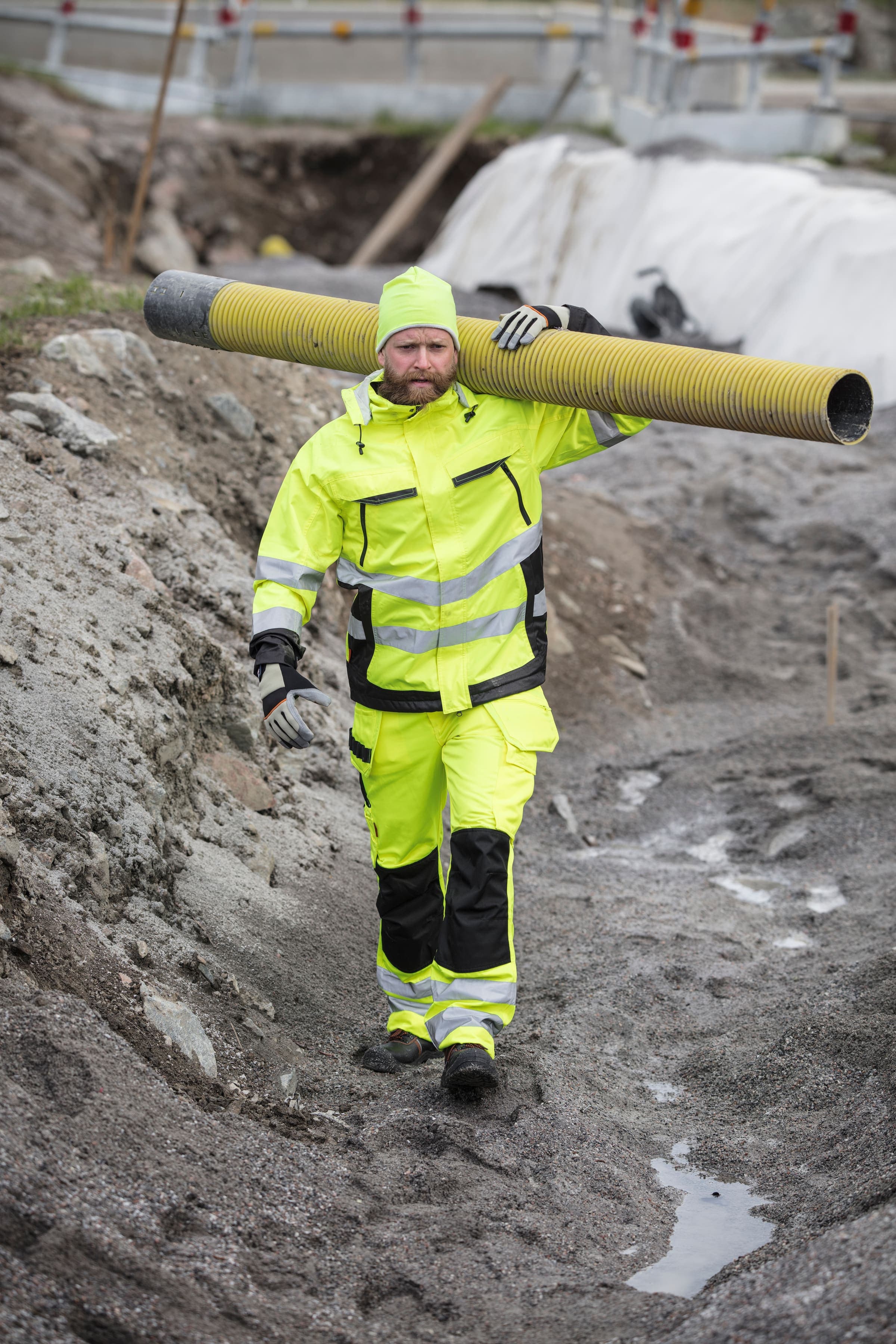
Visibility is another critical element. EN ISO 20471 Class 2 or 3 is common for high-visibility garments, and many operators require Class 3 for outdoor work. Reflective tape must be at least 50 mm wide and positioned around the torso, arms and legs for 360-degree visibility. Choose high-quality reflective material that retains its performance through repeated industrial wash cycles.
The layering principle is fundamental to comfort in demanding conditions. A complete outfit typically consists of a base layer that wicks moisture away from the body, a mid layer that insulates, and an outer layer that protects against weather and hazards. Every layer must be compatible with the others and meet the relevant safety standards. A flame-retardant jacket is no use if the base layer underneath is made of meltable synthetic fabric.
ENGEL has specialised offshore collections that meet every relevant NORSOK requirement. The ENGEL Safety+ range is a popular choice, combining inherently flame-retardant materials with high wearing comfort, certified to EN ISO 11612 and EN 1149-5. As a direct partner, Universe Profile has full access to the entire Safety+ range, including special variants for welding, arc flash and chemical exposure.
When it comes to branding offshore workwear, there are important limits to be aware of. On flame-retardant garments, both the badge and the thread must be approved for the garment, for example an FR transfer or FR thread. Placement follows the manufacturer’s documentation. We assess every garment individually, and you approve a proof before anything is produced.
Remember to weigh the total cost as well. Cheap workwear that has to be replaced often rarely pays off in the long run. A quality garment lasts longer and gives better protection and comfort. We recommend fewer, better garments per employee.