
Blog · Regulations
Who should pay for workwear, the employer or the employee?
Who pays for workwear, the employer or the employee? The answer depends on whether the garment is protective equipment or ordinary workwear. We clear up the rules and the practice.

The employer must always pay for protective equipment and protective clothing the work requires, free of charge to the employee. Ordinary workwear with no protective function is not mandated by law, and who pays is then decided by the collective agreement, the employment contract or company policy. In practice most serious employers also cover branded workwear because it strengthens the brand.
Few topics spark more debate in the workplace than who picks up the bill for workwear. To give a clear answer we have to separate two categories that are treated very differently: statutory protective equipment and ordinary workwear. Confusing the two is the most common source of misunderstanding.
When must the employer pay for workwear?
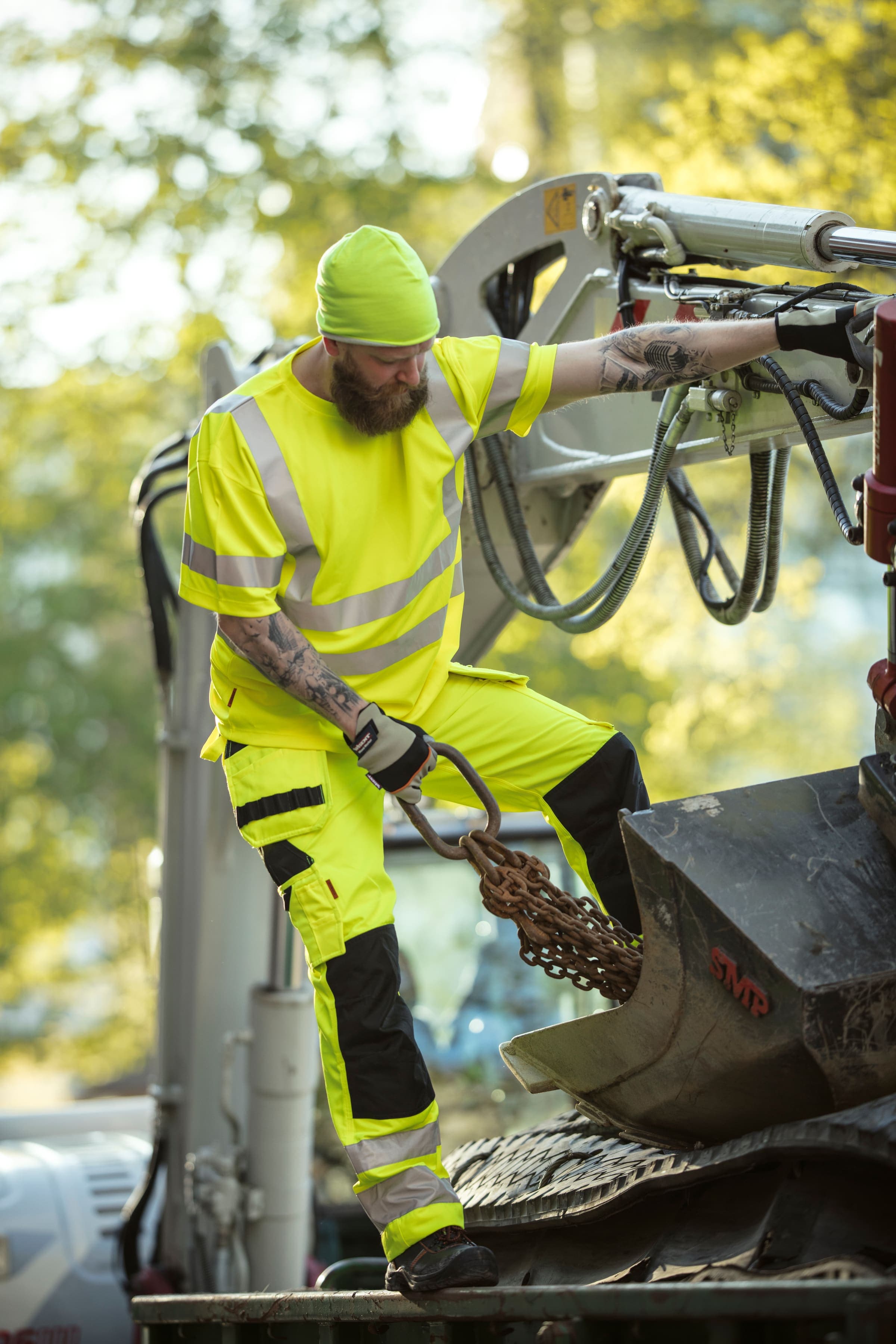
The employer must pay when the garment is necessary protective equipment. This follows from the Working Environment Act and the related regulation, which establish that personal protective equipment is provided free of charge when a risk assessment calls for it. Examples include flame-retardant clothing in industry, high-visibility clothing on a construction site, safety boots, helmets and gloves. The employer also covers maintenance and replacement.
Can the employer deduct workwear from pay?
For statutory protective equipment, the answer is no. The employer cannot shift the cost of necessary protective equipment onto the employee, whether through direct payment or salary deduction. For ordinary workwear with no protective function, an arrangement can in principle be agreed, but any salary deduction still requires a legal basis or a written agreement with the employee under the Working Environment Act. We always recommend that the employer covers branded workwear in full.
Who pays in different situations?
A simple overview: Protective equipment and protective clothing, for example flame-retardant or high-visibility clothing, are always paid for by the employer. Branded workwear with no protective function is paid for by the employer if the collective agreement or policy says so, and in practice most do. Private clothes the employee chooses to wear at work are paid for by the employee. A garment that is both protective equipment and branded, for example a logo high-visibility jacket, follows the protection requirement and is paid for by the employer.
What does the collective agreement say about workwear?
Many national agreements have their own provisions on workwear. Several construction and industry agreements stipulate that the employer provides a set number of garments per year, or covers clothing up to a given value. Check the relevant agreement for your industry, or ask your union representative. Where there is no collective regulation, the employment contract and company policy apply.
Why does it pay for the employer to cover workwear?
Even though branded workwear is not always required by law, it is a sound investment for the employer. Consistent, branded clothing creates a professional impression with customers, strengthens the brand and increases employees’ sense of belonging. In addition, a company’s spending on workwear is normally tax-deductible. For many businesses the indirect return in visibility and reputation far exceeds the cost.
Our advice is to formalise the arrangement in a written policy that clearly states which garments are covered, how often they are renewed, and how handover, washing and return work. It removes doubt and gives employees predictability.
At Universe Profile we set up complete workwear programmes for businesses, from choosing garments and standards to branding and logistics. To see how your logo looks on relevant garments, use the Design Studio, or ask for a quote and we will help you find a cost-effective solution.